

From Sticky Notes to Strategy
Use an impact vs. effort matrix to mine the best ideas from the brainstorming pile.

We’ve all been there: the room is buzzing with ideas, the whiteboard is covered in multi-colored sticky notes, and everyone’s excited. Then, the caffeine wears off, the meeting ends, and there’s no plan for moving forward.
The hardest part of brainstorming isn’t the thinking—it’s the editing.
You can’t implement everything. Budget, bandwidth, and sanity won’t allow it. To turn that wall of paper into a roadmap, you need an impact vs. effort matrix. This idea evaluation tool will help you know where to start.
Create your matrix
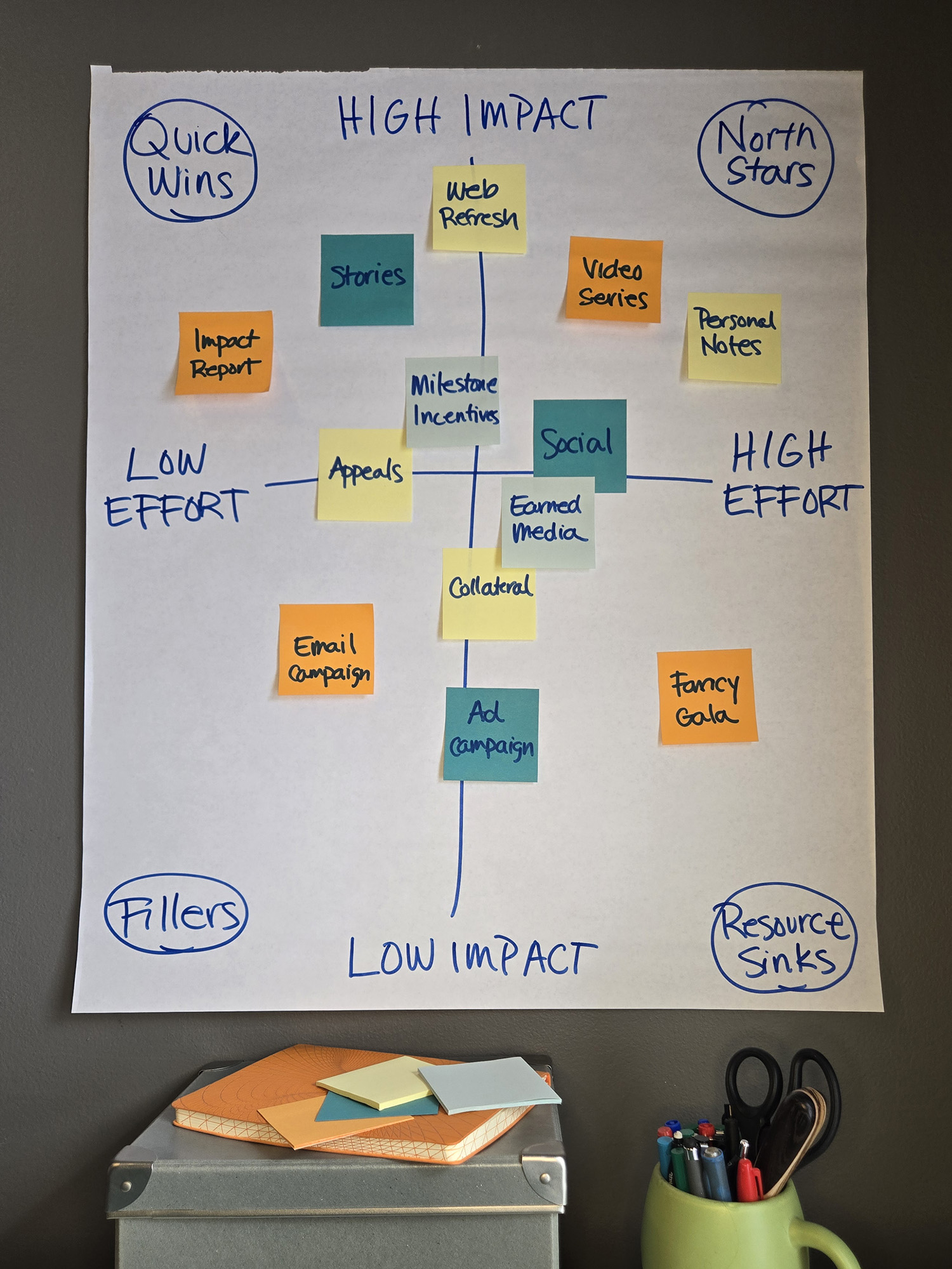
Draw a large grid. At the top, write “High Impact,” at the bottom, “Low Impact.” On the left, write “Low Effort,” on the right, “High Effort.” Now, take every idea and plot it. This visualizes the why behind your decisions and ensures your team is aligned on what actually moves the needle. You’ll end up with four quadrants:
- The quick wins (high impact/low effort)
These are your low-hanging fruit. They provide immediate value without draining your resources. If an idea is easy and will make a difference, move it to the top of your to-do list to build momentum. - The north stars (high impact/high effort)
These ideas guide your long-term direction but require a journey to reach. They won’t happen overnight, and they might be expensive, but they are essential for long-term growth. These belong in your quarterly goals, not your afternoon tasks. - The fillers (low impact/low effort)
These are the nice-to-haves. They are easy to knock out, but don’t move the needle much. Do them when you have a gap in your schedule or use them as training tasks for new team members. - The resource sinks (low impact/high effort)
A technical term for where time and money go to die. They take a lot of work for very little reward. If an idea lands here, toss it in the bin. But don’t forget why you did that. These ideas have a way of creeping back into the mix.
Pro-tip: Before placing ideas on the grid, give every stakeholder three “dots” or votes. The ideas with the most dots are the ones you plot first. This prevents the “Highest Paid Person’s Opinion” (HIPPO) from dominating the grid.
Define your metrics
To plot these accurately, you need to define what impact and effort mean for your specific team.
What is impact?
Don’t decide this in a vacuum. Involve your stakeholders and ask:
- Customer value: Does this solve a burning pain point for our users?
- Revenue: Will this help hit our funding or sales targets?
- Morale: Will this make our employees’ lives significantly better?
What is effort?
Ask the people who actually do the work. The person sending the newsletter or writing the code knows the hidden costs better than anyone.
- Capital: Do we have the budget?
- Time: Does the staff have the hours?
- Skill: Do we have the expertise in-house, or do we need to hire?
The takeaway
The matrix is more than just a sorting tool—it’s a consensus builder. It allows everyone to see why you are moving forward with some initiatives and letting others go.
Stop drowning in too many good ideas and start executing the right ones. Grab a whiteboard (physical or digital), draw your four squares, and turn that wall of sticky notes into a roadmap.

The Best-Run Meetings
5 tips to make your meetings more effective.

Better Questions Lead to Better Ideas
Are you asking the right questions in your brainstorming sessions?

What is Good Content?
A checklist to help you create content that will make your customers take notice.